Checkpointing and Persistence
This notebook shows how to keep a genetic search reproducible and recoverable. Long-running searches should be able to write intermediate checkpoints, save the fitted search object, and load it again later for inspection or prediction.
Menu
Create a compact classification problem
The breast cancer dataset is small enough for a tutorial, but it still has enough features for the optimizer to make meaningful choices.
[1]:
from pathlib import Path

import pandas as pd
from sklearn.datasets import load_breast_cancer
from sklearn.ensemble import RandomForestClassifier
from sklearn.metrics import accuracy_score, balanced_accuracy_score, roc_auc_score
from sklearn.model_selection import StratifiedKFold, train_test_split

from sklearn_genetic import (
    EvolutionConfig,
    GASearchCV,
    OptimizationConfig,
    PopulationConfig,
    RuntimeConfig,
)
from sklearn_genetic.callbacks import ConsecutiveStopping, ModelCheckpoint, TimerStopping
from sklearn_genetic.plots import plot_fitness_evolution
from sklearn_genetic.schedules import ExponentialAdapter, InverseAdapter
from sklearn_genetic.space import Categorical, Continuous, Integer

data = load_breast_cancer(as_frame=True)
X = data.data
y = data.target

X_train, X_test, y_train, y_test = train_test_split(
    X,
    y,
    test_size=0.25,
    stratify=y,
    random_state=42,
)

X_train.shape, X_test.shape
[1]:
((426, 30), (143, 30))
Configure a search with checkpoints
ModelCheckpoint writes the current estimator configuration and logbook during the fit. This is useful for long runs, interrupted sessions, or for storing the generation history next to experiment artifacts.
The regular save and load methods are different: they persist the fitted GASearchCV object after training, so it can be restored later for prediction and analysis.
[2]:
artifact_dir = Path("ga_artifacts")
artifact_dir.mkdir(exist_ok=True)

checkpoint_path = artifact_dir / "breast_cancer_ga_checkpoint.pkl"
saved_search_path = artifact_dir / "breast_cancer_ga_search.pkl"

param_grid = {
    "n_estimators": Integer(40, 160),
    "max_depth": Integer(2, 12),
    "min_samples_leaf": Integer(1, 8),
    "max_features": Continuous(0.25, 1.0),
    "criterion": Categorical(["gini", "entropy", "log_loss"]),
    "class_weight": Categorical([None, "balanced"]),
}

warm_start_configs = [
    {
        "n_estimators": 80,
        "max_depth": 5,
        "min_samples_leaf": 2,
        "max_features": 0.7,
        "criterion": "gini",
        "class_weight": None,
    }
]

callbacks = [
    ModelCheckpoint(checkpoint_path),
    ConsecutiveStopping(generations=6, metric="fitness_best"),
    TimerStopping(total_seconds=180),
]
Fit with optimizer controls
This example combines persistence with smart initial populations, warm-start seeds, adaptive probabilities, local refinement, diversity control, fitness sharing, caching, and automatic parallel execution.
[3]:
cv = StratifiedKFold(n_splits=3, shuffle=True, random_state=42)

search = GASearchCV(
    estimator=RandomForestClassifier(random_state=42, n_jobs=1),
    cv=cv,
    scoring="roc_auc",
    param_grid=param_grid,
    evolution_config=EvolutionConfig(
        population_size=14,
        generations=10,
        crossover_probability=ExponentialAdapter(initial_value=0.85, end_value=0.45, adaptive_rate=0.08),
        mutation_probability=InverseAdapter(initial_value=0.18, end_value=0.55, adaptive_rate=0.12),
        keep_top_k=4,
    ),
    population_config=PopulationConfig(
        initializer="smart",
        warm_start_configs=warm_start_configs,
    ),
    runtime_config=RuntimeConfig(
        use_cache=True,
        parallel_backend="auto",
        n_jobs=-1,
        verbose=False,
    ),
    optimization_config=OptimizationConfig(
        local_search=True,
        local_search_top_k=2,
        local_search_steps=2,
        local_search_radius=0.12,
        diversity_control=True,
        diversity_threshold=0.2,
        diversity_stagnation_generations=3,
        diversity_mutation_boost=1.8,
        random_immigrants_fraction=0.15,
        fitness_sharing=True,
        sharing_radius=0.25,
    ),
    refit=True,
)

search.fit(X_train, y_train, callbacks=callbacks)
search.best_params_, search.best_score_
Checkpoint save in ga_artifacts\breast_cancer_ga_checkpoint.pkl
Checkpoint save in ga_artifacts\breast_cancer_ga_checkpoint.pkl
Checkpoint save in ga_artifacts\breast_cancer_ga_checkpoint.pkl
Checkpoint save in ga_artifacts\breast_cancer_ga_checkpoint.pkl
Checkpoint save in ga_artifacts\breast_cancer_ga_checkpoint.pkl
Checkpoint save in ga_artifacts\breast_cancer_ga_checkpoint.pkl
Checkpoint save in ga_artifacts\breast_cancer_ga_checkpoint.pkl
Checkpoint save in ga_artifacts\breast_cancer_ga_checkpoint.pkl
Checkpoint save in ga_artifacts\breast_cancer_ga_checkpoint.pkl
Checkpoint save in ga_artifacts\breast_cancer_ga_checkpoint.pkl
Checkpoint save in ga_artifacts\breast_cancer_ga_checkpoint.pkl
INFO: TimerStopping callback met its criteria
INFO: Stopping the algorithm
[3]:
({'n_estimators': 42,
  'max_depth': 8,
  'min_samples_leaf': 4,
  'max_features': 0.8576422839762377,
  'criterion': 'gini',
  'class_weight': None},
 0.9904600381598474)
[4]:
y_pred = search.predict(X_test)
y_proba = search.predict_proba(X_test)[:, 1]

pd.Series(
    {
        "accuracy": accuracy_score(y_test, y_pred),
        "balanced_accuracy": balanced_accuracy_score(y_test, y_pred),
        "roc_auc": roc_auc_score(y_test, y_proba),
    }
).to_frame("test_score")
[4]:
| test_score | |
|---|---|
| accuracy | 0.951049 |
| balanced_accuracy | 0.945597 |
| roc_auc | 0.993082 |
The fit statistics summarize how much work was done. They are useful when comparing runs with different population sizes, smart initialization, caching, local search, or diversity controls.
[5]:
pd.Series(search.fit_stats_).to_frame("value")
[5]:
| value | |
|---|---|
| evaluated_candidates | 298 |
| unique_candidates | 293 |
| cross_validate_calls | 293 |
| cache_hits | 5 |
| duplicate_candidates | 0 |
| skipped_invalid_candidates | 0 |
| population_parallel_batches | 12 |
| population_serial_batches | 0 |
| random_immigrants | 15 |
| local_refinement_candidates | 4 |
[6]:
history = pd.DataFrame(search.history)
history[
    [
        "gen",
        "fitness_best",
        "fitness",
        "fitness_max",
        "unique_individual_ratio",
        "genotype_diversity",
        "stagnation_generations",
    ]
].tail()
[6]:
| gen | fitness_best | fitness | fitness_max | unique_individual_ratio | genotype_diversity | stagnation_generations | |
|---|---|---|---|---|---|---|---|
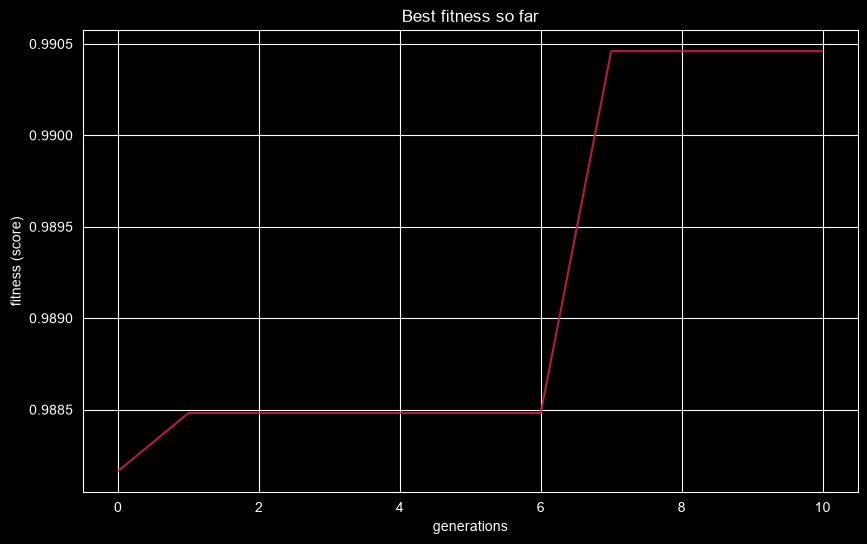
| 6 | 6 | 0.988481 | 0.986634 | 0.987951 | 0.785714 | 0.320513 | 5 |
| 7 | 7 | 0.990460 | 0.987086 | 0.990460 | 0.785714 | 0.410256 | 0 |
| 8 | 8 | 0.990460 | 0.986912 | 0.988905 | 0.714286 | 0.294872 | 1 |
| 9 | 9 | 0.990460 | 0.986813 | 0.988128 | 0.785714 | 0.410256 | 2 |
| 10 | 10 | 0.990460 | 0.986846 | 0.989612 | 0.714286 | 0.320513 | 4 |
[7]:
plot_fitness_evolution(search)
[7]:
<Axes: title={'center': 'Best fitness so far'}, xlabel='generations', ylabel='fitness (score)'>
Inspect checkpoint contents
The checkpoint callback stores a dictionary with two top-level keys: estimator_state and logbook. The state is intentionally lightweight and focuses on the search configuration; the logbook contains the generation records.
[8]:
checkpoint = ModelCheckpoint(checkpoint_path).load()

checkpoint.keys(), len(checkpoint["logbook"])
[8]:
(dict_keys(['estimator_state', 'logbook']), 11)
[9]:
sorted(checkpoint["estimator_state"].keys())
[9]:
['algorithm',
 'crossover_probability',
 'cv',
 'diversity_control',
 'diversity_mutation_boost',
 'diversity_stagnation_generations',
 'diversity_threshold',
 'estimator',
 'fitness_sharing',
 'generations',
 'local_search',
 'local_search_radius',
 'local_search_steps',
 'local_search_top_k',
 'mutation_probability',
 'param_grid',
 'population_size',
 'random_immigrants_fraction',
 'scoring',
 'sharing_alpha',
 'sharing_radius']
Save and reload the fitted search
Use save after fitting when you want to preserve the full fitted search object. Reloading into a fresh GASearchCV instance restores the fitted estimator, history, best parameters, and prediction methods.
[10]:
search.save(saved_search_path)

restored_search = GASearchCV(
    estimator=RandomForestClassifier(random_state=42, n_jobs=1),
    cv=cv,
    scoring="roc_auc",
    param_grid=param_grid,
)
restored_search.load(saved_search_path)

restored_predictions = restored_search.predict(X_test)

pd.Series(
    {
        "same_predictions": (restored_predictions == y_pred).all(),
        "restored_accuracy": accuracy_score(y_test, restored_predictions),
        "restored_best_score": restored_search.best_score_,
    }
).to_frame("value")
GASearchCV model successfully saved to ga_artifacts\breast_cancer_ga_search.pkl
GASearchCV model successfully loaded from ga_artifacts\breast_cancer_ga_search.pkl
[10]:
| value | |
|---|---|
| same_predictions | True |
| restored_accuracy | 0.951049 |
| restored_best_score | 0.99046 |
Clean up generated files
Keep this cell commented when you want to inspect the artifacts after the notebook finishes.
[11]:
# for path in [checkpoint_path, saved_search_path]:
#     path.unlink(missing_ok=True)
# artifact_dir.rmdir()
Practical notes
Use
ModelCheckpointfor progress recovery and audit trails during a fit.Use
saveandloadfor fitted search objects that need to be reused for prediction or later analysis.Store checkpoints outside temporary notebook directories for long runs.
Keep
random_statefixed across the estimator, splitter, and search inputs when you need repeatable artifacts.